
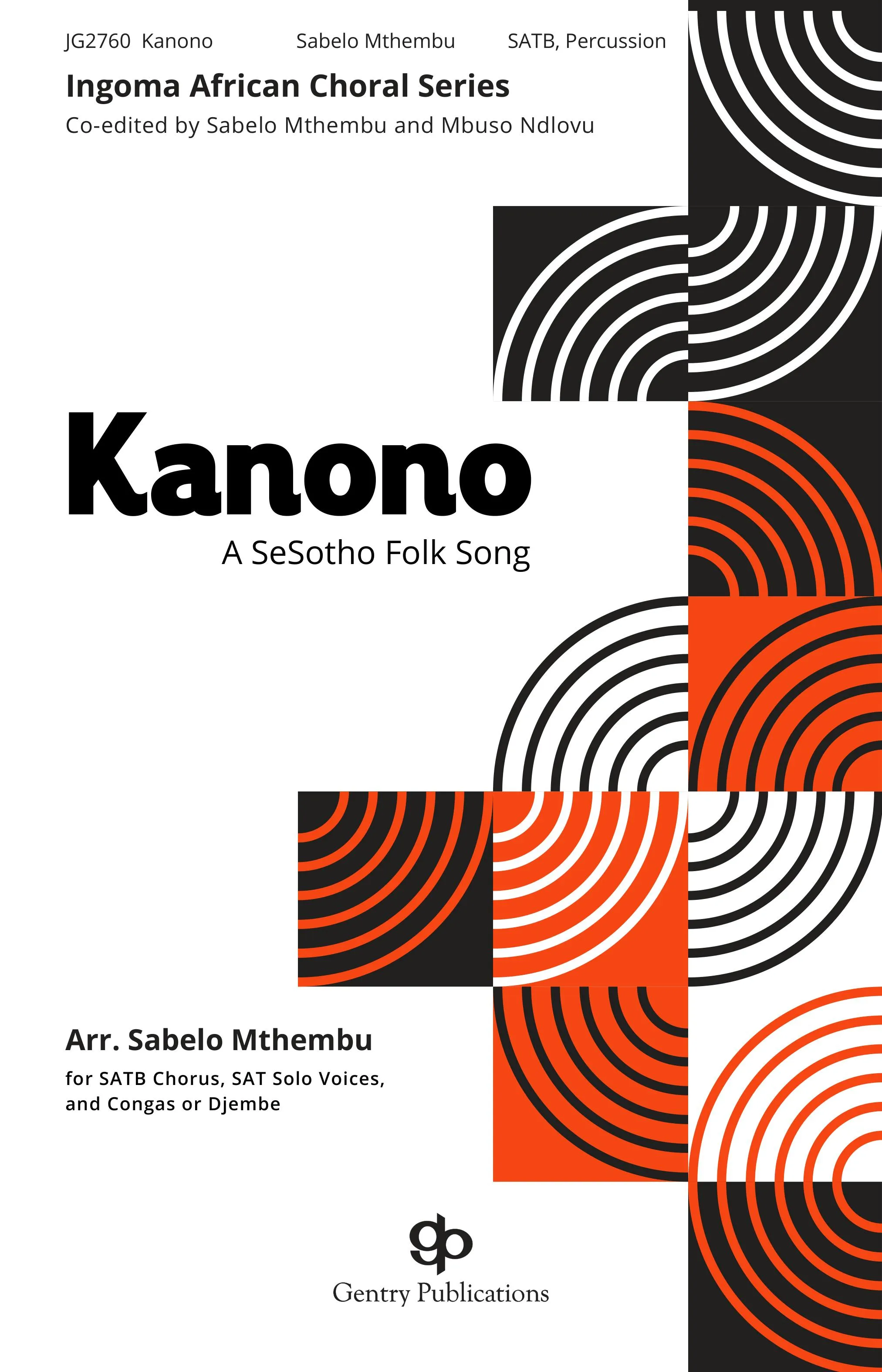
Kanono – All Products
Price range: $3.30 through $3.35
Description
Looking for a perfect piece to showcase cultural heritage that your singers will love? Look no further. “Kanon,” arranged by Sabelo Mthembu, is a powerful SeSotho folk song for mixed SATB choir and percussion. It features vibrant rhythms and rich textures, embodying the Sotho concept of “Tau” (lion)—a symbol of esteemed leaders whose wisdom roars like a cannon. With pronunciation guides and notated conga parts, this piece adds depth and excitement to your performance. Ideal for highlighting the rich choral traditions of South Africa.
SCORE SPOTLIGHT: KANONO
A Spirited SeSotho Folk Song of Rhythm, Respect, and the Power of a Lion’s Roar
Traditional SeSotho Folk Song
Arranged by Sabelo Mthembu
SATB Chorus, SAT Solo Voices, and Congas or Djembe
JG2760 | Gentry Publications
About the Piece
Kanono is a fast-moving, rhythmically alive setting of a traditional SeSotho folk song, arranged by South African conductor, singer, and composer Sabelo Mthembu. Built around the image of a roaring lion, the piece draws its meaning from a Sotho cultural expression of reverence and respect.
In Sotho culture, a person of high position or stature—a king, president, family elder, or community leader—may be called “Tau,” meaning “Lion.” The title recognizes the wisdom and authority carried by that person. When such a leader speaks, the message resonates. The folk text compares that voice to the roar of a lion and, in turn, to the powerful sound of a cannon.
The central text is direct:
“Eh utlwang ha e luma
Ah! iyo! Iyo!
Tau ha e luma e tshwana le kanono”
Translated:
“Hear the lion roar.
It sounds like a cannon.”
A Voice Heard Before the Choir
Mthembu’s arrangement begins with a tenor soloist calling into the musical space at a brisk fast swing tempo of quarter note equals 135. The full choir does not immediately answer with a dense wall of sound. Instead, sustained “Ah” sonorities emerge beneath and around the solo line while the conga or djembe establishes the rhythmic foundation. This opening creates a clear relationship between the individual voice and the larger ensemble.
That relationship continues throughout the first half of the work. Solo material returns, including an alto soloist and later an SAT trio, while the SATB choir responds through repeated phrases, sustained harmony, and rhythmic text. The effect is one of musical conversation rather than a conventional melody simply passed through four choral parts.
Rhythm as the Musical Engine
The percussion part is remarkably focused. After its entrance, the conga or djembe repeatedly drives the piece with a persistent swing-based rhythmic pattern combining duple subdivisions and triplet figures. Rather than functioning as occasional decoration, the percussion becomes the musical floor beneath nearly the entire arrangement.
For the choir, this creates an important performance consideration: the singers must live inside the rhythmic groove. Many of the vocal ideas are constructed from short, recurring fragments of text and melody. Their effectiveness depends on precision, buoyancy, and unified rhythmic placement. This is not music that should feel heavy or overly vertical. Even sustained choral writing must remain connected to the forward energy established by the percussion.
The conductor’s work is therefore less about forcing momentum and more about protecting it. Once the pulse is secure, the repeated phrases can feel spontaneous, conversational, and increasingly energized.
Building the Choir One Voice at a Time
One of the arrangement’s most effective structural moments arrives at measure 37. Mthembu creates an extended buildup in which the voice parts enter over successive repetitions. The basses enter first, followed by tenors and altos, with the sopranos joining later to complete the four-part texture. The score specifically identifies this section as “a buildup of all voice parts, from basses to sopranos, completing the full four-part harmony.”
This is more than a clever layering device. The audience hears the ensemble being constructed in real time.
Each new vocal layer adds another rhythmic idea to the texture. The basses provide sustained “Ah” material. Tenors and altos introduce their own repeating text fragments. The soprano line eventually completes the composite texture. By the seventh repetition, the accumulated vocal material has become a densely interlocking choral fabric.
For singers, this section offers a particularly satisfying ensemble experience. Each section has a distinct role, but the complete musical effect only becomes apparent when the independent patterns are heard together.
From Layered Voices to a Unified Roar
After the layered buildup, Mthembu gradually brings the musical strands into greater alignment. At measure 47 the texture intensifies, with vocal ideas overlapping across the ensemble before the entire SATB choir arrives in coordinated rhythmic writing at measure 49.
That transition is one of the most compelling elements of the arrangement.
The piece begins with a single tenor voice. It expands through choral response, additional solo voices, repeated phrases, and independent layers. Then the choir increasingly moves together. By the final pages, all four sections proclaim the text through closely coordinated rhythmic gestures over the continuing percussion groove.
The musical architecture mirrors the central image of the text: a voice with enough presence to be heard and felt.
The ending does not need an exaggerated theatrical gesture. At measure 55 the ensemble returns to the strong “Eh!” material at forte. The final measures broaden with a rallentando, allowing the repeated “E-tshwa-no” figures and sustained closing harmony to settle naturally after the rhythmic intensity of the piece.
About Sabelo Mthembu
Born in Johannesburg, South Africa, in 1983, Sabelo Mthembu began his musical career in the church and developed his work as a singer, conductor, composer, and music director. He co-founded the Quava Vocal Group after leaving the University of Johannesburg Choir in 2008. Since its formation in 2009, the ensemble has grown from six to sixty-nine singers and has earned international recognition, including gold medals at the 2018 World Choir Games and the 2022 Interkultur World Choral Cup in Spain, where Mthembu was named Best Conductor.
His work also extends into jazz and African music. His debut album, Songs of Brotherhood, was released in 2013, and his single “Angiphili Mawungekho” reached number two on the iTunes South Africa Jazz Charts in 2015.
A Closer Look at the Score
Kanono is a piece in which repetition creates momentum rather than predictability. Mthembu takes a relatively concise body of text and continually changes the listener’s relationship to it.
First, the text is heard through a solo voice.
Then the choir answers.
A second solo color appears.
The percussion maintains the pulse.
Independent vocal ideas begin to accumulate.
The SAT trio adds another focal point.
Finally, the full choir increasingly speaks as a unified ensemble.
The result is a carefully controlled musical escalation. The score feels immediate and energetic, but its architecture is highly deliberate. The excitement of the final pages has been prepared from the opening tenor call.
Why This Piece Matters
Kanono gives choirs the opportunity to explore rhythmic ensemble singing, layered vocal textures, solo leadership, and music rooted in SeSotho language and cultural imagery. The arrangement’s repeated musical ideas make its structure understandable to the listener, while the staggered vocal buildup and persistent percussion groove give the work a strong sense of forward motion.
Most importantly, Mthembu does not treat the lion merely as an exotic or dramatic image. The cultural context supplied with the score connects “Tau”—the lion—to reverence, wisdom, leadership, and the power of a respected voice.
In Kanono, one voice calls.
Others listen.
The choir gathers.
And eventually, the entire ensemble roars.
Additional information
| Catalog # | JG2760 |
|---|---|
| Voicing | |
| Series | |
| Composers | |
| Authors | |
| Accompaniment | |
| Style | |
| Release Date | |
| Season | |
| Difficulty | |
| Publisher |
Recently Viewed Products
-
 Deck The Hall - All Products $3.35
 -
 Meu Parana - SATB $3.60
 -
 Hamba Kahle Mkhonto - SATB $3.60
 -
 Still, I See Them - SATB - Digital $3.60
0 Comments