
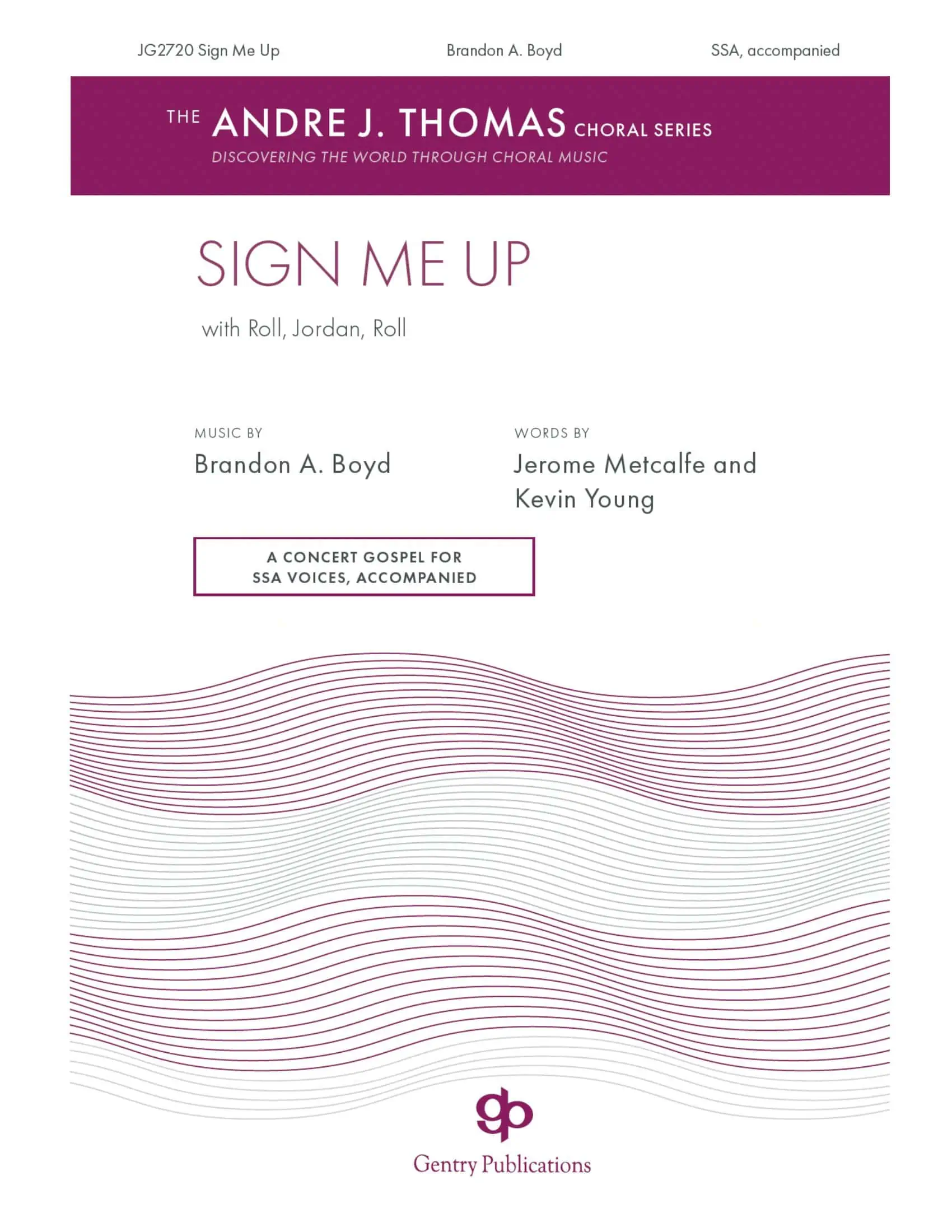
Sign Me Up – SSAA
$3.75
Description
“Sign Me Up” by Brandon A. Boyd—ignite your concert with this vibrant original composition for treble chorus. From the first note, experience its spirited gospel vibe, engaging both singers and pianists. It’s more than a song; it sparks discussions about life goals and dreams, inviting students to explore their aspirations. With optional orchestral accompaniment, it delivers a powerful, inspiring performance, offering a journey into possibilities and purpose. Also available in SATB and TTBB settings.
Sign Me Up – SSAA Treble Choir by Brandon A. Boyd
Sign Me Up by Brandon A. Boyd is a vibrant concert gospel work for SSAA treble choir that brings together rhythmic drive, strong choral writing, and a musical connection to the African American spiritual “Roll, Jordan, Roll.” With an energetic accompaniment for piano, bass, and drums and an optional orchestral setting, Boyd creates a piece that asks treble singers to sing with precision, conviction, and a genuine sense of groove. Gentry Publications classifies the work as Medium difficulty and publishes it as part of the Andre J. Thomas Signature Series.
For conductors looking for contemporary SSAA choral music, gospel repertoire for treble choir, an SSA-style concert selection for upper voices, or music by an important contemporary composer, Sign Me Up offers a particularly strong combination of accessibility, musical substance, and performance energy.
The piece is unmistakably informed by gospel style, but Boyd approaches that language with the craft of an experienced choral composer and conductor. Percussive vocal effects, active rhythmic writing, and the interaction between choir and accompaniment give the music momentum from the beginning. The result is not simply a spiritual arrangement and not simply a gospel song placed in a concert setting. It is a concert work that draws on both traditions and asks singers to engage seriously with style as well as notes and rhythms. Gentry describes the piece as combining gospel and classical choral elements while quoting the familiar spiritual Roll, Jordan, Roll.
Brandon A. Boyd: Composer, Conductor, and Choral Educator
The name Brandon A. Boyd carries considerable weight in contemporary American choral music.
Dr. Boyd is the Director of Choral Activities, Director of the Graduate Choral Conducting Program, Associate Professor of Music, and Mary M. and Harry L. Smith Endowed Chair at the University of Missouri. There he conducts the University Singers, Sankofa Chorale, and Choral Union Symphonic Chorus while teaching graduate conducting, choral literature, and arranging.
His professional work extends well beyond the university. Boyd has served as chorus master, assistant conductor, and guest pianist with the London Symphony, prepared ensembles for performances of Porgy and Bess with the NDR Elbphilharmonie Orchestra and Vokalensemble, and has guest conducted organizations including the Nashville Symphony, Missouri Symphony, and St. Louis Symphony. His work has also taken him to Carnegie Hall in several capacities, including guest conductor, composer, and collaborative pianist.
He is also an active composer and arranger whose music is performed in the United States and internationally. In addition to composing, Boyd serves as Executive Choral Editor of Gentry Publications and is deeply involved in identifying, developing, and promoting new choral repertoire.
That breadth of experience matters in a piece such as Sign Me Up. Boyd understands the music from several sides at once: as a composer, conductor, educator, pianist, and scholar of the choral tradition. The writing is designed not only to make an immediate impression in performance, but also to give singers and conductors something worthwhile to work on during rehearsal.
Why SSAA Choral Repertoire Matters
Although directors sometimes use “SSA music” as a broad search term for treble repertoire, Sign Me Up is specifically written for SSAA voices.
That extra fourth part is important.
SSAA writing allows a treble ensemble to develop a full four-part choral texture without relying on tenor or bass voices. Two soprano and two alto parts can create greater harmonic depth, independent inner lines, antiphonal effects, and a richer range of ensemble color than is possible in a standard three-part SSA setting.
For established treble choirs, women’s choruses, collegiate ensembles, high school advanced treble groups, and honor choirs, that can be musically significant. Treble choirs deserve repertoire conceived for their sound rather than arrangements that feel like reduced versions of mixed-choir literature.
A strong SSAA piece allows the ensemble itself to be the destination.
Sign Me Up does that particularly well because its energy does not depend on low voices to create weight. The rhythmic foundation comes from the accompaniment and the singers’ own articulation, pulse, and ensemble confidence. The four vocal parts can therefore concentrate on harmony, rhythmic interaction, and vocal intensity while bass and drums provide an instrumental foundation beneath the choir.
For a developing ensemble, the piece can become a useful way to strengthen independence across four parts. For a more advanced treble choir, it offers opportunities to refine rhythmic precision, diction, balance, stylistic authenticity, dynamic contrast, and ensemble stamina.
Just as importantly, energetic SSAA repertoire gives treble singers opportunities to perform music that is bold, rhythmically driven, and physically engaging. Treble programming does not need to be limited to lyrical, delicate, or reflective literature. Sign Me Up gives the ensemble permission to sing with considerable power and personality.
The Connection to “Roll, Jordan, Roll”
One of the most meaningful musical elements in Sign Me Up is Boyd’s use of “Roll, Jordan, Roll.”
The spiritual is part of the historic African American sacred-song tradition and was documented well before the end of the nineteenth century. It holds a particularly important place in the written history of spirituals because “Roll, Jordan, Roll” appears as the opening selection in the landmark 1867 collection Slave Songs of the United States, compiled by William Francis Allen, Charles Pickard Ware, and Lucy McKim Garrison.
The song developed within African American religious life during slavery, and its imagery carried multiple layers of meaning. The biblical Jordan River traditionally represents passage into the Promised Land. Within African American spiritual practice, that image could also speak more broadly to deliverance, release from suffering, freedom, and the hope of a different life beyond present circumstances.
That history gives Boyd’s quotation of the spiritual considerably more significance than a familiar melodic reference.
In Sign Me Up, Roll, Jordan, Roll connects the contemporary concert-gospel language of the piece with a much older tradition of communal singing, testimony, aspiration, and deliverance. Boyd does not need to turn the work into a historical lesson for that connection to be heard. The musical quotation itself brings the past into conversation with the new material.
For choir directors, it also creates an opportunity for meaningful rehearsal-room discussion. Singers can learn something about the history of the spiritual, the role of communal singing in African American musical traditions, and the way contemporary Black composers continue to engage with inherited musical material.
That contextual work can deepen the performance. Rather than simply singing gospel-inflected rhythms because they sound exciting, students begin to understand the tradition in which the musical language participates.
Concert Gospel for Today’s Treble Choir
From the opening accompaniment, Sign Me Up establishes a strong rhythmic identity. The piano writing is not merely supportive; it helps determine the attitude and momentum of the performance. Bass and drums can further reinforce that foundation, and an optional orchestral accompaniment provides directors with the possibility of expanding the piece for a larger festival, honor choir, or special concert setting.
That makes the relationship between singers and accompaniment particularly important.
The choir cannot simply sing accurately on top of the instrumental parts. Singers need to feel how their consonants, entrances, accents, and releases interact with the groove. When that rhythmic relationship is secure, the piece can sound spontaneous and energized while remaining tightly controlled.
This makes Sign Me Up an excellent vehicle for teaching the difference between singing rhythmically correct notes and actually singing in a rhythmic style.
The vocal writing also gives conductors an opportunity to explore the meeting place between classical ensemble technique and gospel performance practice. Breath support, vowel unity, balance, and precision remain essential, but they serve a musical language that should communicate directly and confidently.
Part of the Andre J. Thomas Signature Series
Sign Me Up is published by Gentry Publications as part of the Andre J. Thomas Signature Series, with Dr. André J. Thomas serving as series editor.
That association is particularly appropriate.
Throughout his distinguished career as a conductor, composer, educator, and specialist in African American choral traditions, André J. Thomas has had an enormous influence on the way spirituals and gospel-influenced repertoire are taught and performed by concert choirs. The Gentry series bearing his name includes repertoire intended for school, collegiate, and professional ensembles and reflects Thomas’s longstanding commitment to significant choral music from a wide range of traditions.
For directors familiar with Thomas’s work, inclusion in the Andre J. Thomas Signature Series provides useful context for Sign Me Up. This is repertoire intended to be taken seriously as concert music while remaining connected to the musical traditions from which it draws.
Where Can “Sign Me Up” Be Programmed?
The combination of gospel energy, SSAA voicing, and meaningful historical connections makes Sign Me Up flexible enough for a wide range of programs.
It can be particularly effective for:
High school treble choirs seeking an energetic SSAA selection with substantial musical content
College and university women’s or treble choirs looking for contemporary gospel-influenced repertoire
All-State and honor treble choirs needing a work with immediate energy and enough depth for intensive rehearsal
Community treble ensembles interested in African American choral traditions and contemporary concert gospel
Black History Month concerts when programmed with appropriate historical and cultural context
Gospel and spiritual programs that connect traditional African American repertoire with contemporary composers
Festival performances where an ensemble needs a strong rhythmic contrast to more lyrical repertoire
Concert closers that can finish a program with momentum and conviction
Programs about hope, purpose, aspiration, transformation, or journey
Programs featuring music by Black composers and arrangers
Concerts exploring the evolution of the African American spiritual into later gospel and concert traditions
Because the piece invites singers to think about aspirations, goals, and possibilities for their own lives, it can also work especially well with high school and collegiate singers at transitional moments—graduation concerts, final concerts of the year, honor choir festivals, or programs focused on looking toward the future. Gentry specifically notes the work’s potential for encouraging conversations about goals, dreams, and aspirations.
Also Available for SATB and TTBB Choirs
Although this edition is specifically designed for SSAA treble chorus, Sign Me Up is also available in SATB and TTBB voicings.
That flexibility can be especially useful for school districts, universities, festivals, and multi-choir programs.
A choral department could introduce the work to a mixed SATB ensemble, a tenor-bass choir, or an SSAA treble choir while choosing the version that best serves its singers. It also opens interesting possibilities for directors who want different ensembles within the same program or institution to encounter Boyd’s musical language.
For directors specifically searching for SSAA choir music, however, the treble edition deserves attention in its own right. It is not simply valuable because another SATB version exists. The four-part treble texture gives the work its own vocal identity and makes it a significant option for ensembles looking to build a repertoire that treats SSAA singing as a complete choral medium.
A Strong Choice for the Modern Treble Choir
Sign Me Up succeeds because several musical worlds meet without losing their individual character.
The piece has the energy and rhythmic immediacy of gospel music, the ensemble discipline of concert choral writing, and a historical connection to one of the enduring African American spirituals. Brandon A. Boyd brings those elements together in a way that reflects his own unusually broad experience as a composer, conductor, educator, pianist, and leader in contemporary choral music.
For choir directors searching for SSAA gospel music, contemporary treble choir repertoire, an SSA or SSAA choral piece by a Black composer, African American spiritual-inspired concert music, or an energetic piece for advanced high school or collegiate treble choir, Sign Me Up offers both immediate performance appeal and substantial material for musical study.
It gives treble singers something they deserve: repertoire that expects them to sing with independence, rhythmic authority, stylistic awareness, and a full, confident ensemble sound.
Sign Me Up
Composer: Brandon A. Boyd
Text: Jerome Metcalfe and Kevin Young
Voicing: SSAA Treble Choir
Accompaniment: Piano, Bass, Drums, Optional Orchestra
Style: Concert Gospel
Difficulty: Medium
Publisher: Gentry Publications
Series: Andre J. Thomas Signature Series
Series Editor: André J. Thomas
Also available: SATB and TTBB
Additional information
| Catalog # | JG2720 |
|---|---|
| Voicing | |
| Composers | |
| Authors | |
| Accompaniment | |
| Style | |
| Release Date | |
| Content | |
| Season | |
| Difficulty | |
| Publisher | |
| Series | |
| Series Editor | |
| Status |
0 Comments